Bringing Back the Ospreys
by David R. Zimmerman
Excerpted from Newsday (Suffolk Edition),
Sunday, Aug 20, 1972 ·Page 222
Newsletter editor’s note: The following article brings to light the history of a project in the late 1960s to move healthy Osprey eggs from nests in the Chesapeake Bay area to nests in our region where productivity levels had been destroyed by DDT poisoning. It also reveals an allbutforgotten detail: nests on Fishers Island played a key role in confirming the success of this restoration effort. Paul Spitzer, the man who conceived the egg-moving solution that arguably saved the Osprey population in the Northeast, will be speaking at the HLFM on July 12, 2026, 4:00pm.
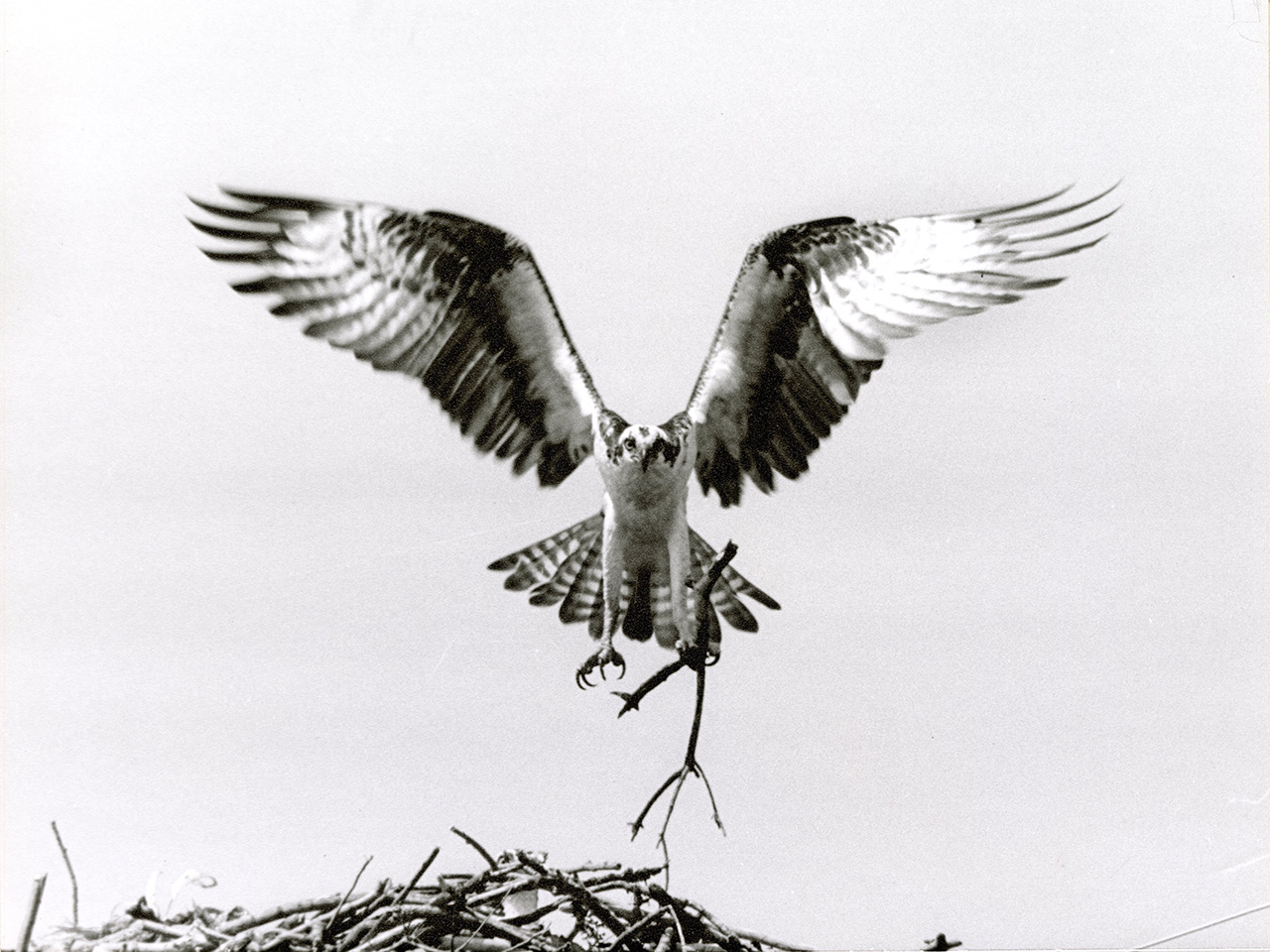
Female on nest as male Osprey delivers stick, circa 1970s. Photo by Charles Morgan
ON SUMMER WEEKENDS, visitors to Long Island’s East End may have seen a young man step out of a battered old car with a canoe lashed to its roof and then climb a utility pole to check a huge nest on its top.
The man is Paul Spitzer, 25, who has come up with an experiment he hopes will help save the Island’s threatened osprey population. As an article in this magazine noted earlier this year, ospreys are one of a number of wildlife species facing extinction in this area. DDT has damaged the bird’s reproductive processes, and only a small number of ospreys still nest in such places as Gardiners Island, around Gardiners Bay and on Shelter Island.

Paul Spitzer inspecting Osprey 1971. Photo by Roger Tory Peterson
Spitzer, a friend and neighbor of ornithologist Roger Tory Peterson in Old Lyme, Conn., devised a solution for saving the osprey which sounds so simple that a schoolboy might have thought of it. Starting in 1968, Spitzer began moving baby ospreys and eggs from nests near Chesapeake Bay, where there was less pollution and thus a higher hatch rate, to nests in the Connecticut River estuary and nearby Long Island Sound locations.
His hope was that the essentially barren local birds would foster the transferred young, which then might fledge, migrate, and return to Long Island Sound—not Chesapeake Bay—when their time came to breed three or four years later. Spitzer marked them with bright-colored plastic leg bands and streamers, or jesses, so that later he could identify them from a distance.

Paul Spitzer with camera telescope to keep track of Fishers Island Ospreys 1972.
By last year, Spitzer had succeeded in the first parts of his experiment. He had demonstrated that osprey eggs and chicks can be moved safely hundreds of miles by canoe, plane and car, and would be accepted readily by their northern foster parents, from whose nests they successfully fledged. The big unanswered question was: Would they return to Long Island Sound to breed?
If so, then egg transfer might be a workable way to keep the Long Island osprey colony’s traditions and migratory habits alive until the environment could be cleansed enough for the birds to reproduce themselves unaided.
While a few transferred birds had been due back last year—and could not be found—this past spring, 1972, was a critical test. Up to 10 or a dozen of them might be expected. Spitzer planned to examine by telescope every osprey nesting along the four-state littoral of New York, Connecticut, Rhode Island and southern Massachusetts to find them.
He began in the chill of late March, visiting the massive stick nests that osprey pairs return to year after year. March ended: no birds. In April, most of the birds that were coming back came back. Spitzer, cartopping his battered canoe on an ancient blue sedan, zigzagged back and forth across the Sound from Connecticut to Long Island, and to the Sound’s lesser islands -Shelter, Gardiners, Plum and Fishers—where, beside somewhat less polluted waters, many of the remaining ospreys are to be found.
It was a long quest—Long Island alone has hundreds of miles of coastline—but not a lonely one. Besides the half dozen or so conservationists who work directly with him, Spitzer, now a graduate student at Cornell, has developed a network of landowners, birdwatchers and other osprey aficionados who help keep track of the birds and serve as unofficial wardens to protect their nests.

Paul Spitzer using mirror to check hatch in Osprey nest, Connecticut River estuary, June 2016.
Many nests are on private property, to whose owners Spitzer is beholden for access. He has won the help of Robert Gardiner, the garrulous Lord of the Island Manor, and of Gardiner’s gruff-spoken manager, Jock Mackay. Shelter Island’s husky police commissioner and ferry captain, Benjamin Byington, watches—and watches over—the birds, as does Dr. J.J. Callis, who is chief of the highly quarantined Communicable Animal Disease Research Station on Plum Island. A mosquito-control worker on Orient Point, Elisha Habermann, monitors the ospreys from the marshes he tends. On Fishers, Spitzer has the help of schoolteacher, Edwin Horning, and an occasional assist from a utilities worker who will boost him up to a pole top nest in the bucket lift of his maintenance truck. The crew of one ferry wave Spitzer and his car aboard for free, and on the New London-Orient Point run he is a guest at table in the galley.
Following his informants’ directions to each uncharted nest, Spitzer “scoped” ospreys all through April. No Maryland birds could be found. Reporting his progress in a phone interview early in May, his voice sounded faint and far away. He was, he said, running out of birds. He was extremely downcast. Then, on Sunday morning, May 7, Spitzer’s luck changed. He rode out early with a companion from New London to Fishers Island, the dragon-shaped outpost of New York State that swims in the Sound close by the Connecticut-Rhode Island border. Fishers is a highly private, upper-class retreat of large estates and quiet shores; tourists and transients are not warmly welcomed.
Spitzer found his Maryland bird there, a 3-year-old male. He had mated a native-born female. Their nest was atop a telephone pole alongside the Island’s main road. The male osprey was wearing a faded red plastic band on one leg, a faded yellow one on the other. This identified him as a transfer bird brought north in his egg in 1969. He had been hatched, raised and fledged by foster parents in a nest near the glide path to Trumbull Airport in New London, about eight miles as an osprey flies from the nest on Fishers where, in his maturity, he now was starting his family. Encouragingly, moreover, his mate’s eggs felt heavy and fertile when Spitzer climbed up to weigh them.
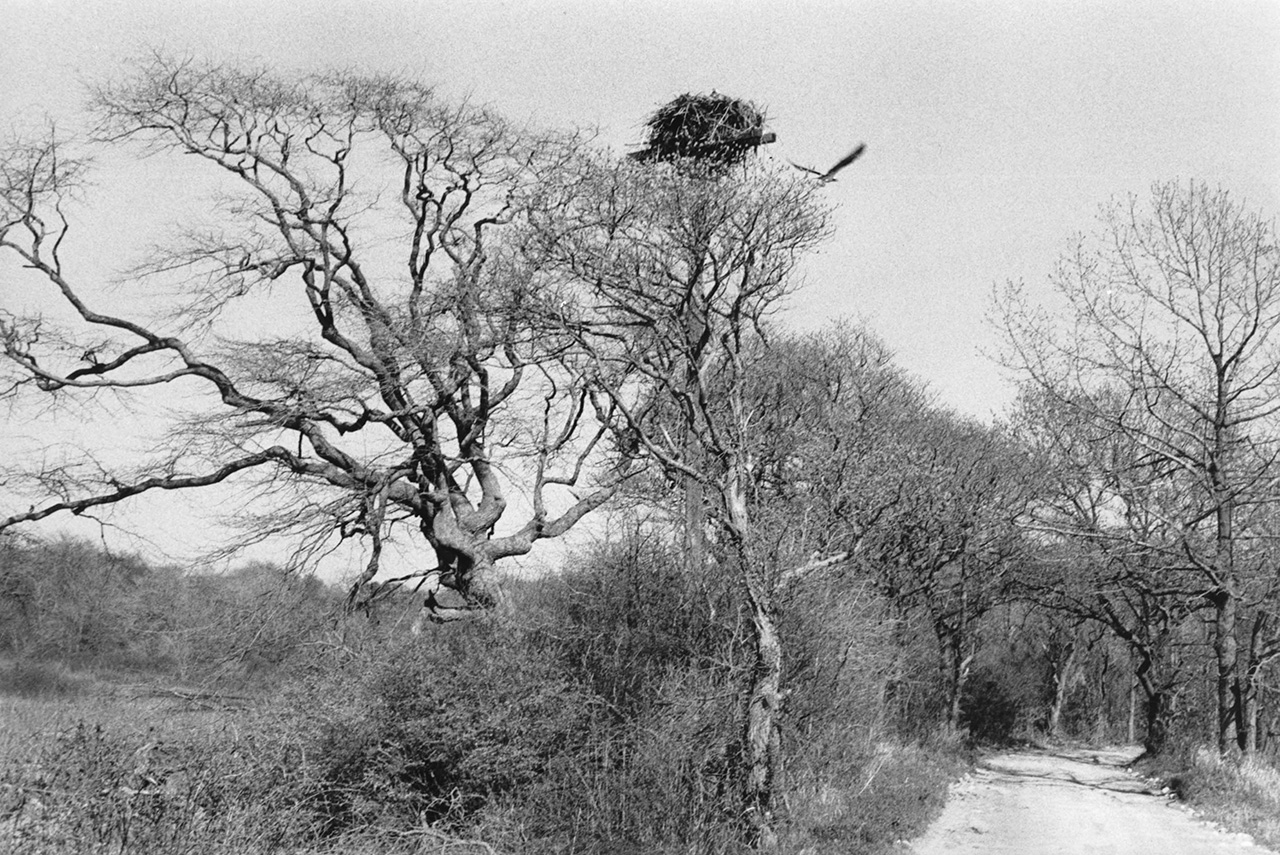
Osprey nest along Middle Farm Road, circa 1990. Photo by John Wilton
Then, there were more good finds. A second Maryland bird, a 4-year-old female, turned up breeding on Shelter Island. Spitzer had moved her, as a 20-day hatchling, to a nest on Great Island, near Old Lyme. She had lost her color markings, but retained a U.S. Fish and Wildlife Service lockon metal band. Spitzer first read the identifying band numbers by telescope, then trapped the bird to confirm them.
Three other Maryland birds, a male and two females, all fledged from the Connecticut coast, have returned as 3-yearolds to Gardiners Island. One of the females is breeding. Because of loss of markers, Spitzer believes other unidentified Maryland birds also may be back. He feels that five verified returnees from the 33 Maryland birds fledged in 1968 and 1969 is a good score, since death normally claims two thirds of fledglings before they can breed. Spitzer has proved that ospreys removed as eggs or hatchlings will integrate their “foster homes” into their complex—and still baffling—migratory and homing behavior, and return there two to four years later to breed.
Will such a procedure save Long Island Sound’s ospreys?
The answer is not yet known. Certainly, it could help, along with other conservation techniques that Spitzer and his colleagues are trying . . .
From Newsday. © 1972 Newsday. All rights reserved. Used under license

Dr. Paul Spitzer, Choptank River, Eastern Shore, MD., circa 2015. Photo by T0m Pelton