My Lifelong Osprey Studies: Scientific Adventures on Our Coast
by Paul R. Spitzer
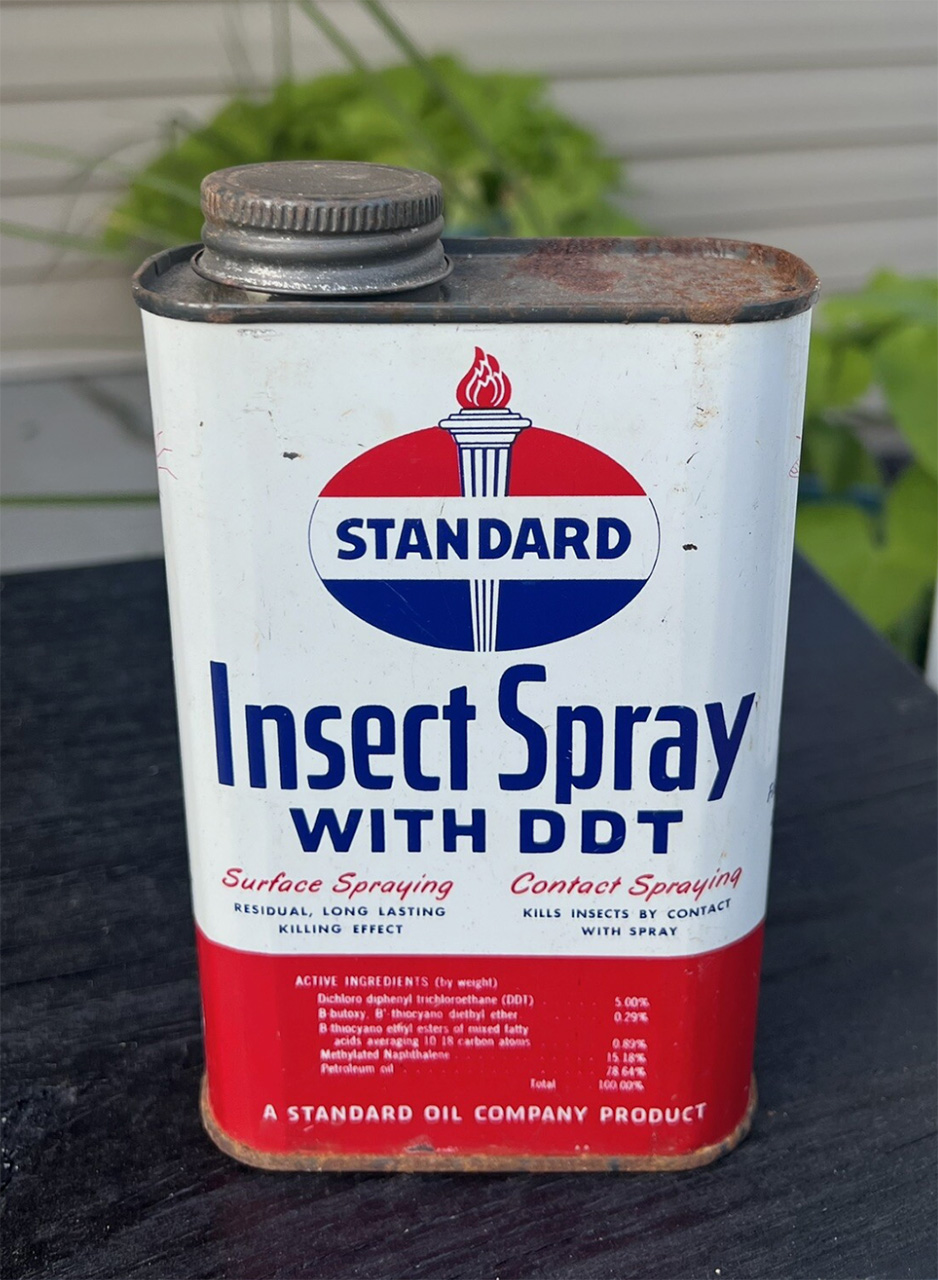
In the spring of 1968, I began a lifelong journey of scientific understanding based on Osprey field study. My Osprey mentors, ornithologist Roger Tory Peterson and his wife Barbara, had moved to Old Lyme, CT, in 1954, partly because of the great Osprey colony of 150 nests centered on the Connecticut River Estuary. By the late 1950s, Roger was finding almost no young in those nests; the colony was in a precipitous crash. Every spring, a Yale graduate student would keep the “death watch,” counting the drastic decline. By 1967, the observer was Tom Lovejoy, who soon departed to begin his famous life’s work protecting the tropical forests of the Amazon. So, in January of 1968, I went to the Petersons and asked if I might continue the study—now reduced to a handful of nests, whose eggs were now known to be highly contaminated with DDT residues. The late Rachel Carson published “Silent Spring” in 1962, but the impact of DDT on Ospreys was yet to be proven—much to Roger’s frustration. The Petersons warmly approved my research and thus began my lifelong ecological adventure. I was a senior at nearby Wesleyan and my progressive advisors allowed much of my last semester to be devoted to Osprey science. They were experimentalists, so they supported my egg switch experiment between the highly contaminated CT eggs and relatively “clean,” viable eggs from Chesapeake Bay. Those transplanted Maryland eggs hatched at their usual, good rate in the CT foster nests, so we knew the viability problem lay within the CT eggs.

Paul Spitzer inspecting an unfledged osprey on ground nest, Gardiners Island, NY, July 1971. Photo by Roger Tory Peterson.
In 1969, I repeated the egg switch with similar results. By that time, researchers in the United Kingdom determined that DDT was thinning Peregrine Falcon eggshells. This clear biomarker became part of the classic DDT toxicology story. That spring, I expanded my nest survey to cover the whole remnant population of Ospreys breeding between New York City and Boston, reduced to 150 nests from 1,000 pre-DDT. I delighted in climbing to tree nests and running ladders up to high pole sites—and I found many thin-shelled eggs collapsing under the incubating Ospreys. This work became my doctoral project, advised by Tom Cade at Cornell. It was a dazzling adventure into scientific field research for a CT schoolboy: A voyage of discovery, crossing Long Island Sound to find the remaining Osprey nest sites in the diverse habitats of Long Island’s East End. The research became my annual spring pilgrimage, shared with genial hosts in lovely places: “How are your Ospreys doing?” On Fishers Island, teacher Ed Horning helped me find the nests. On Plum Island, lab director Jerry Callis and his scientists helped me monitor food chain toxicology by collecting dead eggs. On Shelter Island, police chief Ben Byington let me overnight in the normally empty, impeccably clean town jail. At some sites, we used bucket trucks to access high nest poles, some on power lines. “Don’t touch anything!” was the general policy. Nearby live wires were often quietly fizzing, adding to the excitement of my elevated perch. Robert David Lion Gardiner let me roam his grand Gardiners Island preserve to study the 38 natural nest sites that remained as a remnant of that famous colony. With this shared Osprey fellowship, I came to understand that “Collegiality is the Bread of Life”—a principle I have tried to live by ever since.
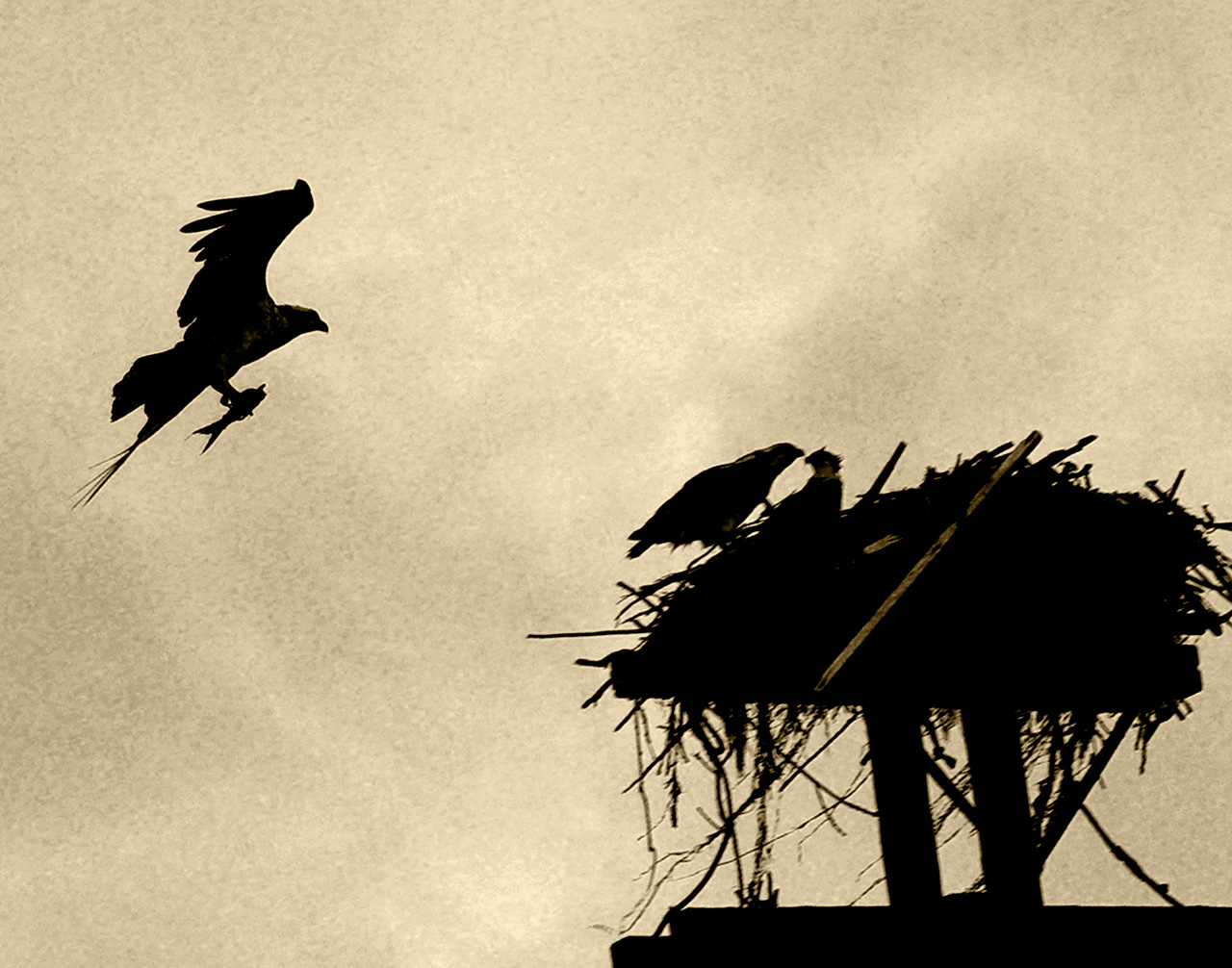
Feeding time at Money Pond, Fishers Island, July 23, 2009. Photo by Timothy J. Hallett.
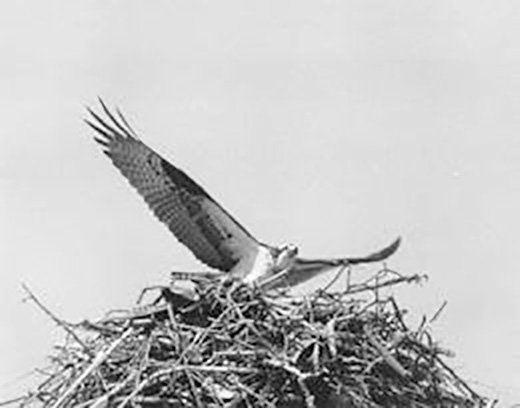
Osprey protecting nest, Fishers Island, c.1980. Photo by John Wilton.
The Federal ban of DDT in 1972 was a triumph for us all. Throughout the 1970s, we monitored the Ospreys’ initial recovery as a result of reduced egg contamination. Each nest site was a data point. The nest colonies on islands and coastlines were data clusters. A core practice of ecological science is measurement to determine process. I color-banded Osprey, then followed these marked individuals for years, collecting their life histories: Age at first breeding, sex-specific dispersal, and annual adult survival. After the many delights of fieldwork, I fitted all that hard-earned data into a population equation. Using my decade of carefully collected population data, I found that the recovering Ospreys needed to fledge only a low, 0.8 young per active nest to be stable: what we term the replacement rate. Thus, my thesis predicted a population explosion when the Ospreys were healthy again, and that is what happened, both here and in Europe.
As the effects of DDT subsided, it became possible to study broader Osprey ecology. The failure of the isolated Gardiners Island nest colony to produce young became our focus. The hatch there was now good, but was followed by massive nestling starvation, with brood reduction from 3 to only 1 young or even complete nest failure. The colony stumbled along with about 20 nests. Surrounded by miles of open bay water habitat, it was dependent on migratory menhaden, a prey base that was apparently very limited for many years, starting around 1995. To this day, menhaden population biology remains a complex scientific and political challenge. The tight schooling, surface-active fish are perfect Osprey prey, but they can be overharvested, and long-term ocean climate cycles may also shape their abundance. The recovery of the famous Gardiners Island Osprey colony followed strong menhaden fishery restrictions in 2012, and the colony is now up to 80+ nests. The Fishers Island nests also benefit from these regional NY-CT harvest limits. Eastern Long Island Sound was a large-scale menhaden fishery in the 19th century, and current Fishers Island nest numbers (15 nests in 2024, fledging 34 young) and large brood sizes (6 of the nests fledged 3 young) indicate renewed menhaden abundance. The coves of serpentine Fishers hold other prey fish species—an annual Osprey food study of nest deliveries might yield interesting discoveries about the diets of Fishers Island’s Ospreys. In stark contrast, some Osprey colonies along the Virginian coast of Chesapeake Bay are currently suffering almost complete reproductive failure. Research seeks to determine whether intense annual menhaden harvest near those sites has severely depleted local menhaden populations. It is heartening to see the robust recovery of Osprey in many locations, including Fishers Island. Still, it is clear that more study of these great birds is needed – my lifelong work, continues.
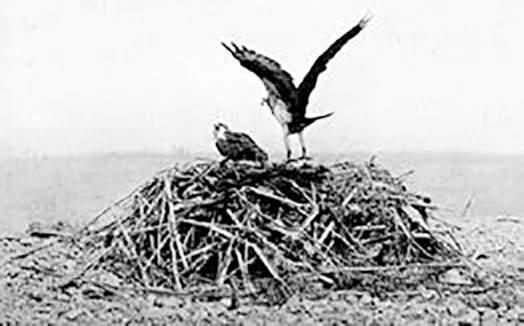
Osprey pair on ground nest, Gardiners Island, circa 191l. Photo by Clinton G. Abbott.

Paul Spitzer using mirror to check hatch in Osprey nest, Connecticut River estuary, June 2016.
Dr. Paul R. Spitzer, a protégé of Roger Tory Peterson, envisioned and promoted the restoration of DDT-decimated Osprey populations in the Northeast in the late 1960s and 1970s. Paul R. Spitzer, 31672 Old Orchard Rd., Trappe, MD 21673.