Restoring Biodiversity with Native Plants
by Jack Schneider, Land Trust Manager
Fishers Island’s landscape has been changing for the past 14,000 years. From tundra to forest to pasture to resort: Each ecological community that was wiped out became replaced by a new community.
Despite this turmoil, nature persisted, albeit challenged and diminished. Native biodiversity has declined while non-native species have increased. Exotic plants and animals have occupied the Island since Winthrop days. More recent imports aided by destabilizing land use practices—and now climate change—are increasingly vigorous and prevalent. The Land Trust is testing several methods to reintroduce biodiversity on our parcels.
Shading and General Cutting
At the Chocomount Cove properties, we’re testing the use of native plants to suppress invasives by shading and cutting. In sunny locations, where invasives like English ivy or stands of glossy buckthorn sprouts spread diffusely across the ground, we’re favoring tall, perennial native species that grow in dense masses, reproducing by rhizomes and/or prolific seed production. These natives cast shade on the surrounding invasives and tolerate being cut back once or twice annually. These can be grasses or forbs.
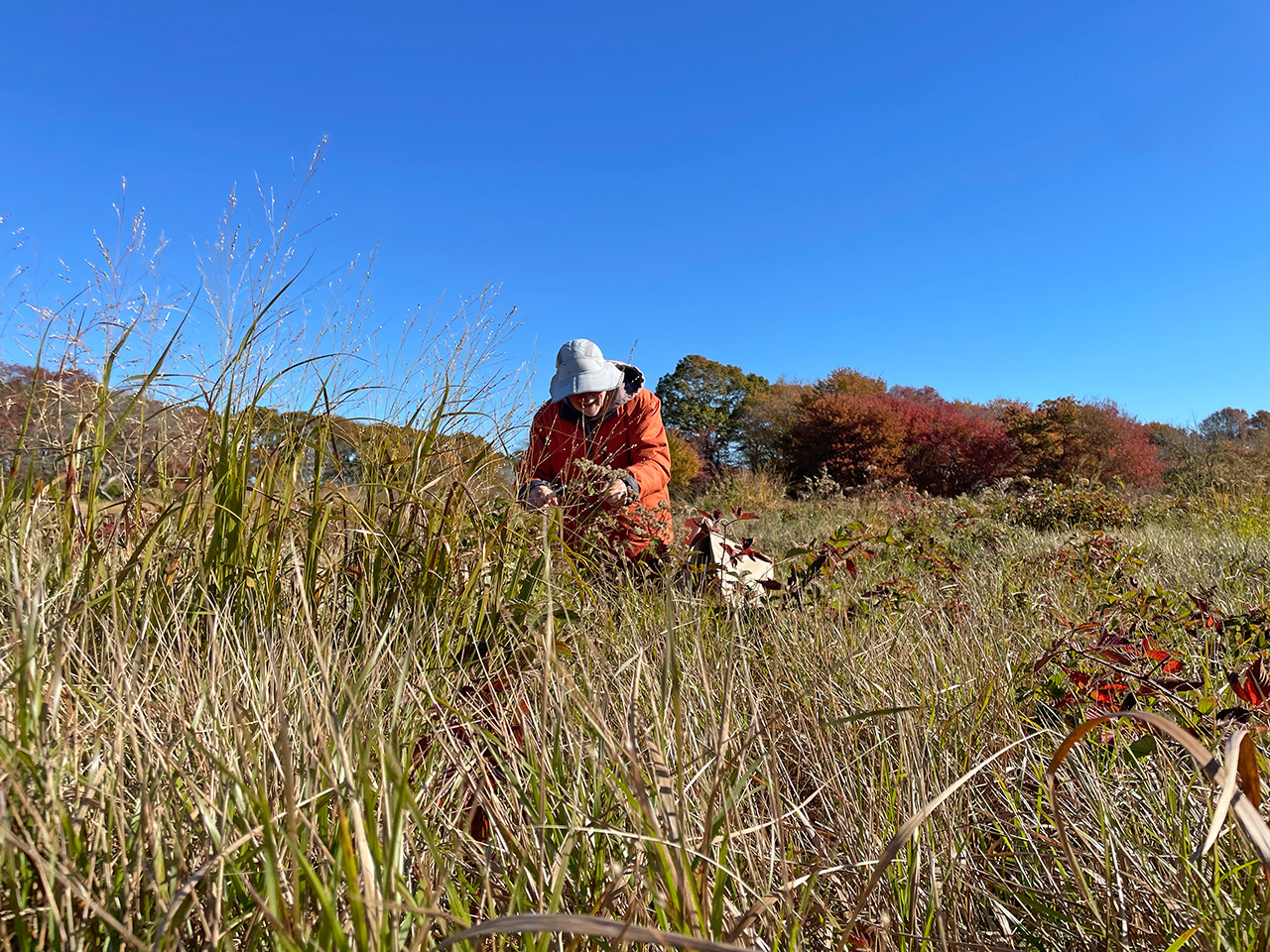
Jack collecting native plant seeds at Middle Farms, Oct. 27, 2025. Photo by Jessica NeJame
Outcompeting and Selective Cutting
In another sunny location, where the invasives are more singular and spaced, like beach rose at Chocomount Cove Beach, we’re planting the natives in the spaces created by cutting back the invasives multiple times during a growing season. As the invasive plant weakens, the native plant grows. All of these parallel planting methods maintain the root structures that assure soil stability, creating a living bulkhead against coastal erosion.
Bolstering Natives
Where invasive species are less of a problem and not our main conservation target, we want to plant natives that enhance the biodiversity of those more stable communities. Native species evolved as part of the Fishers Island ecological communities and are best adapted to survive the Fishers Island soil composition, moisture, and climate.
Additional Benefits
When established in appropriate habitats, natives need neither wasteful water, nor polluting fertilizer, nor harmful insecticides. Each plant species has a role in supporting the entire community, particularly those specialized fungal and animal species that have co-evolved into a mutualistic relationship with the specific plant species. Native plants support the healthy, biodiverse ecosystem characteristic of Fishers Island.
Sourcing Native Plants
We prefer purchasing “straight species” (not cultivated varieties) of plants and seeds with Atlantic Pine Barren provenance. Since Ecoregion 84 sources and species diversity are limited, we source plants from Northeastern Coastal Zone, Ecoregion 59, as well.
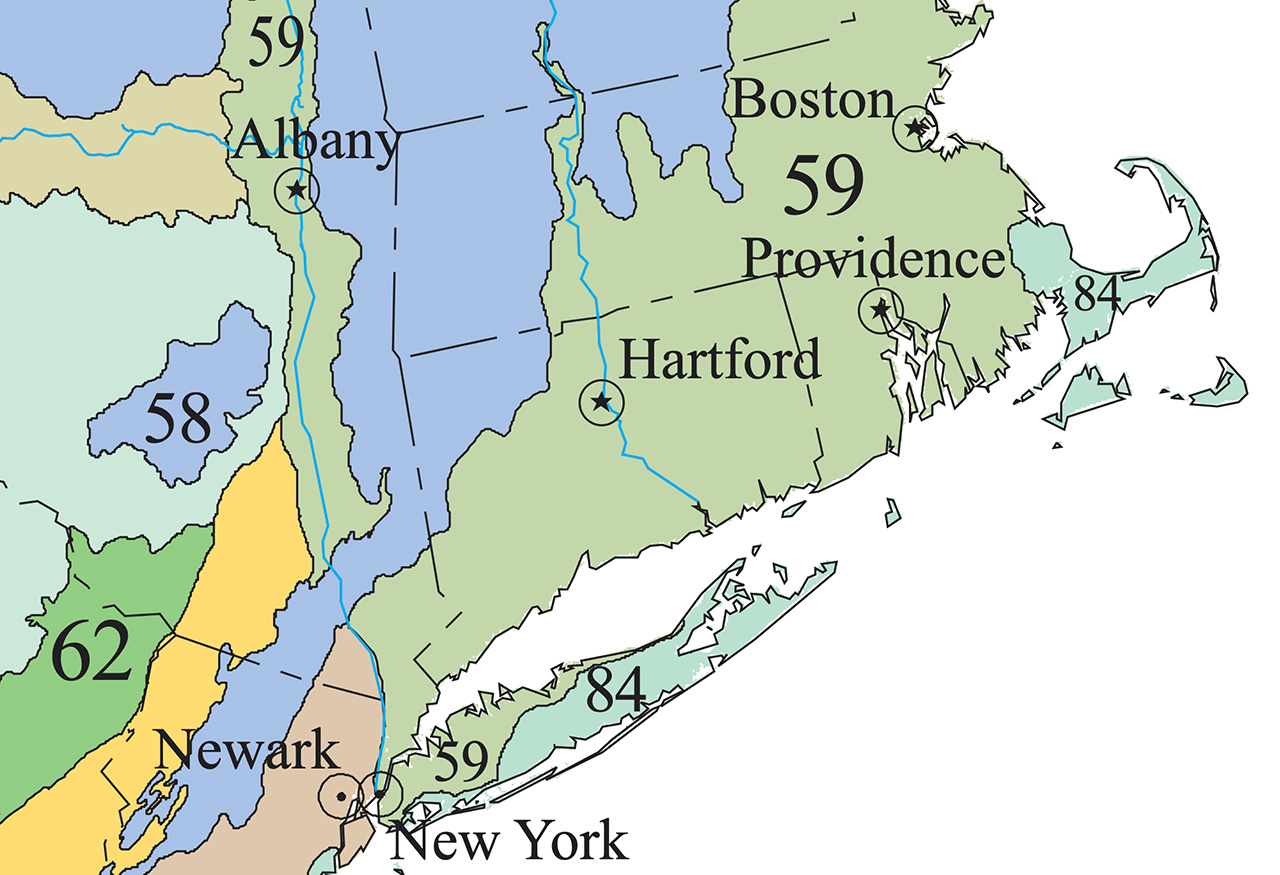
Level III Ecoregions of the Continental United States (Revised April 2013) US Environmental Protection Agency. US EPA
Each region is classified based on biotic and abiotic factors, including geology, topography, vegetation, climate, soils, land use, wildlife, and hydrology. The relative importance of each of these varies from one ecological region to another. Fishers Island and the other nearby areas formed by glacial retreat, are part of the Atlantic Pine Barrens, Region 84.
Southern and Local
In a warming climate, planting species having a more southern provenance enhances longterm landscape resilience, particularly for long-lived, slow to mature trees. However, it is also important to replenish locally, co-adapted plant species to address the impoverished native plant diversity. This provides a critical lifeline to the plummeting native pollinators and other animals, and our native plants and animals may harbor enough genetic diversity to adapt to climate change and persist.
Planting Natives at Home
More information and resources for plants and seeds and native planting programs are available at the Museum and on this website, including the links below.