More on Bald Eagles on Fishers Island
by Jessica NeJame, Land Trust Coordinator
A successful nest of bald eagles on the Island is a great ecological sign, indicating that Bald Eagles along the Connecticut River are expanding. Bald Eagle and other raptor populations (including Osprey) were severely impacted by DDT, and despite the passage of legislation banning DDT and protecting these birds, it has taken decades for populations to recover. Forty years ago, there were no nesting pairs remaining in the Connecticut River Basin, and very few Bald Eagles in all of New England. Now, there are an estimated 55 pairs in Connecticut alone. Bald Eagles are territorial and need a lot of space. Depending on the abundance of their food supply (predominantly fish and waterbirds), their nesting territories can range from 2.5 square miles to as large as 15 square miles. With the Connecticut population rebounding, they need more space, which is likely what led to these new Fishers Island arrivals.
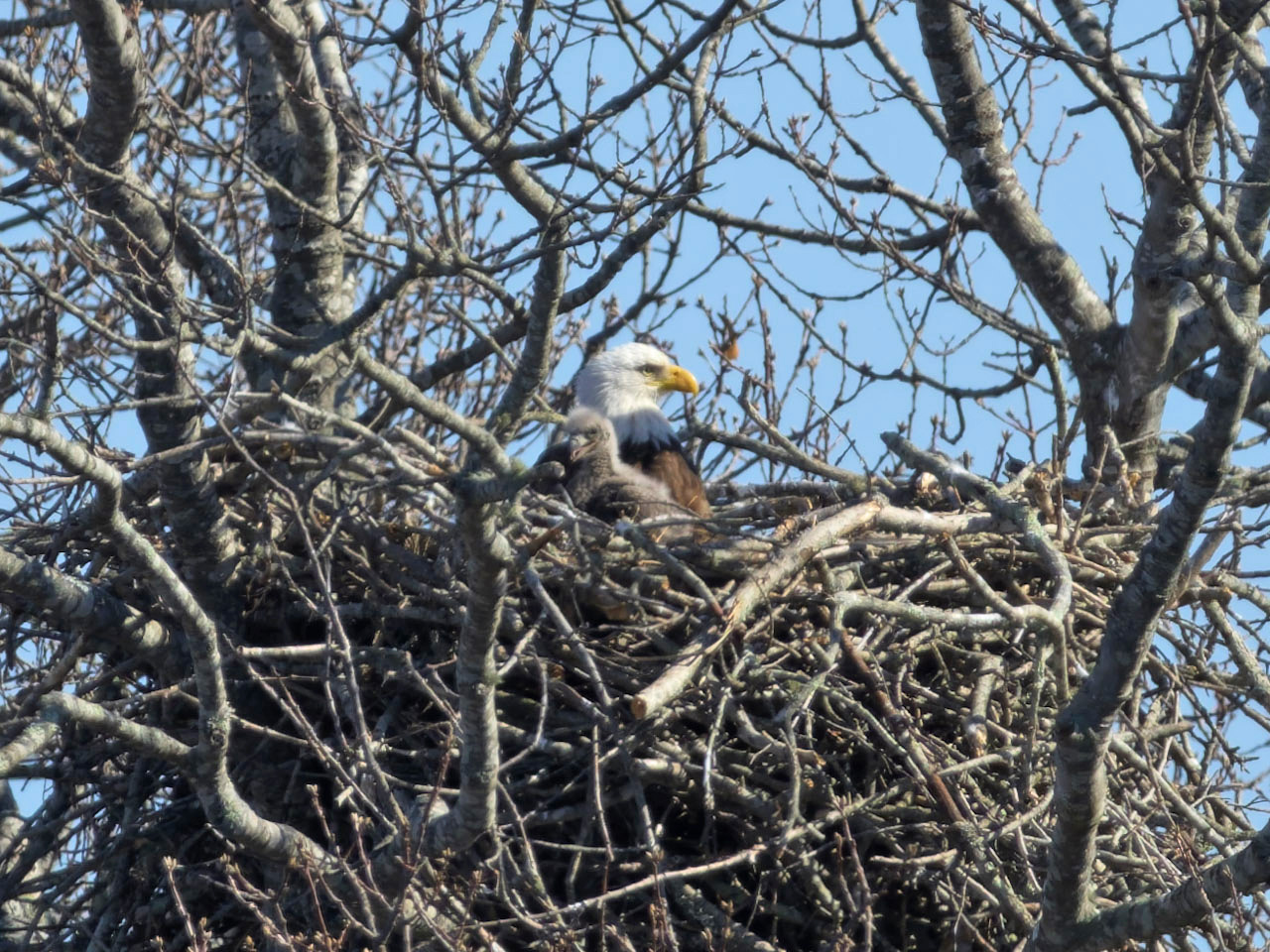
Detail view of eagle and eaglet on nest, April 11, 2026.
Photo by Todd McCormack
Despite being a symbol for strength and bravery, Bald Eagles are quite sensitive, especially in a new nesting site. Eagles are far less tolerant of human activity than Ospreys, and Land Trust staff blocked a portion of the nature trail near the eagle nest in 2025, which may have contributed to its success. We ask that no attempts be made to approach the nest – especially by drones. If they are disturbed, they may abandon their nest, along with its fledgling birds. Moreover, harassing, disturbing or injuring a Bald Eagle is a federal offense and carries a penalty of up to $20,000 and/or one year in jail. Federal law, under the Bald and Golden Eagle Protection Act, mandates a minimum buffer zone of 330 to 660 feet around eagle nests to avoid illegal disturbance. We are considering a blind or remote camera to permit live viewing of the eagles in the nest, but our highest priority at this point is to not disturb the birds until the eaglets are fledged. We will conduct long-distance camera surveillance of the nest and will add photos to our website as they become available.
To avoid distressing the birds, the NY Department of Environmental Conservation recommends the following:
- Remain a quarter mile away when viewing these birds.
- Use binoculars or a spotting scope to help you see the birds.
- Do not try to get closer to the nest to view the birds.
- Refrain from making loud noises.
- Do not use drones or other devices that disturb the birds.
- Do not share exact location on social media to prevent excessive human traffic.
- Respect all posted signs and avoid restricted areas.
It is a privilege to witness this landmark environmental event. If we work together as a community to celebrate these birds and respect their space, hopefully, they will agree that Fishers Island is a great place to raise a family and remain a part of our community for years to come.